An Ancient Oak in Italy Just Turned Out to Be Nearly 1,000 Years Old
While mighty oaks do fall, there are a rare few that can stand for nearly a millennium, even under harsh conditions.
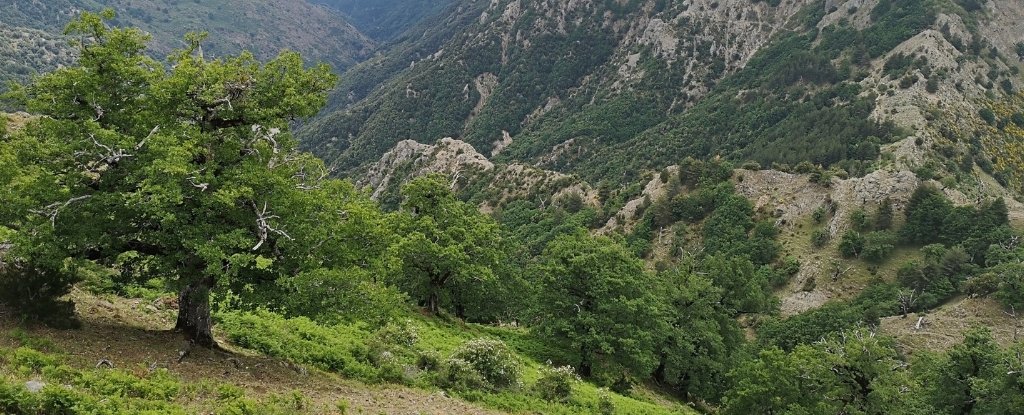 |
Radiocarbon dating has now revealed the oldest temperate hardwood tree in the world sits atop a steep rocky slope in a remote mountain belt of the Mediterranean.
Here, on this rocky precipice in Italy, lives a community of ancient trees. And one of these oaks has withstood freezing temperatures, snow storms, high-speed winds, and drought for over nine centuries, or 934 ± 65 years to be exact.
Even at high elevations - more than 1,000 metres above sea level - it seems that some hardwoods can survive for much longer than we thought.
"These long-lived trees are witnesses of our
past," says Lucio Calcagnile from the University of Salento, Italy.
"The history of our climate, of solar activity, of the
human impact on the environment is registered in their rings and we are sure
that other important discoveries are going to come."
As remarkable as it is, this oak isn't actually the oldest tree on our planet, nor is it even the oldest hardwood tree. Under the right conditions, the softwood in evergreen conifers is known to stand for several thousand years, while flowering trees with hardwood interiors tend to rot out after a few centuries.
Oak trees make it longer than most of their counterparts, but exactly how long is up for debate, especially in areas that are less lush.
Flowering trees, for instance, have been known to exceed a thousand years of age in the rainforests of the Amazon and the savannah of tropical Africa, but in areas with temperate weather, their maximum age is more uncertain.
In the past, tree ring counts have revealed very large temperate oaks in Switzerland, Bosnia and Sweden that were roughly 930 years old, 866 years old, and 600 years old respectively.
But figuring out a tree's age using its rings or a partial
part of its core is not an accurate cross-dated analysis, and some think we
could be overestimating the true age of these oaks when using this method.
Radiocarbon dating may be a better approach. The technique
has already confirmed two old oaks in Romania are something like 645 years old.
Collecting samples of degraded wood from the hollow trunks
of five large oaks in the mountains of Aspromonte National Park in South Italy,
researchers have put this method to the test once again.
"In the Dendrology Lab we carried out a careful
stereoscope screening to identify the oldest rings in our samples,"
explain the authors in a press release.
"Given the very narrow size of the rings, we had to use
a scalpel to collect them."
Even at such high elevations, their analysis reveals the
oaks of Aspromonte are some of the oldest temperate examples in the world - all
five oaks ranged from 570 years to 934 years old.
And the smallest oak sampled - the one with a broken top,
waving its canopy like a flag - was the oldest of them all. This tree,
nicknamed Demeter, was growing outwards at roughly 0.4 mm per year, which
suggests this plant is in it for the long haul.
The oak is probably in no rush to place itself further out
in the elements, especially since light up on these barren slopes isn't exactly
in short supply.
"What makes the Aspromonte sessile oaks unique is not
only the extraordinary age of Demeter but also the ecological niche that they
occupy, which is dramatically different from the plain and hilly territories in
central and northern Europe where other old oaks have been found," the
authors write.
Demeter's extreme age means it has stood over 300 years
longer than two other temperate hardwoods (this time, beech trees), which were
cross-dated to about 620 years last year.
Protected in a remote national park, the authors say this
long-life cycle is a reminder that nature can thrive for millennia given the
space and time.
As its namesake, the Greek mythological goddess of harvest
and Earth's fertility, in many ways Demeter is the embodiment of nature itself.
The study was published in Ecology.
Comments
Post a Comment